ADDY RUTH
Staff / Principal Level Product Designer
Automation  •  AI  •  Industrial UX  •  Decision Intelligence
About Addy

I like the work that happens before anyone agrees on the problem.

I design for the gaps between systems, teams, and workflows—especially where people need to interpret a signal, understand its limits, and make a consequential decision.

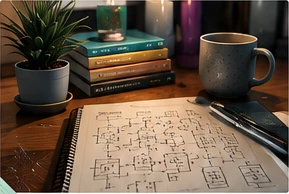
Notebook with a sketched workflow on a desk

For more than 15 years, I’ve worked on enterprise products spanning warehouse automation, freight logistics, industrial data, and financial investigations. The domains change; the questions recur. What is really happening? Who needs to know? What can they safely do next?

At Target, I was the sole UX designer for automation intelligence, working with site teams, Engineering, Operations, and Controls to connect equipment behavior and telemetry to human decisions. Earlier at Redwood, I helped shape tools for brokers, carriers, and customers across the shipment lifecycle. At Cognite and SymphonyAI, the same interest carried into industrial signals and AI-assisted investigations: make evidence and uncertainty understandable without taking judgment away from the person doing the work.

I work from field observation and system mapping through interaction design, prototyping, validation, and rollout support. A good interface does not ask people to forget what they know about the operation. It makes that knowledge easier to share and act on.

The work has crossed the IC and manager line.

My title has not always described the scope. I have formally supervised designers, led a small UX team, guided matrixed designers and front-end engineers, and served as the sole designer setting direction across a platform. These are different kinds of leadership, so I describe each one plainly.

People leadership

Build the team and its operating system

At Reynolds & Reynolds, I was promoted to Design Supervisor and led a 25-person production design team. I redesigned intake, onboarding, templates, and training so quality and delivery were less dependent on overtime or individual memory.

Team leadership

Shape craft and a shared product model

At SymphonyAI, I led a small UX team designing AI-assisted fraud and AML investigations. Shared patterns for evidence, rationale, and case resolution helped the product grow without every workflow becoming a special case.

Matrixed leadership

Align people without a reporting line

At Redwood, I led UX and front-end direction with matrixed designers and engineers. I helped align Design, Engineering, and QA around a delivery process, and participated in design and engineering hiring.

Platform leadership

Set direction as the sole designer

At Target, I owned UX for automation intelligence while working with site teams, Operations, Engineering, and Controls. The leadership work was in research, shared decision models, reusable interface patterns, and validation across live operations.

What was complex, and what became easier to decide?

Complexity is more than a crowded screen. It can be conflicting clocks, incomplete evidence, physical constraints, unspoken expertise, or several teams optimizing different outcomes. I map those conditions, then make the next decision legible while keeping uncertainty and human judgment visible.

Warehouse automation · Target

One building, different clocks

Complexity Operations and engineering tools described the same facility at different speeds; local wins could create downstream losses.

Simplification A shared whole-building model with role-specific context, clearer states, and local drill-down helped teams see when to intervene.

See Material Flow
Freight logistics · Redwood

A shipment crosses organizations

Complexity Brokers, carriers, and customers depended on disconnected information, handoffs, and expertise that did not fit neatly into a form.

Simplification Readiness states, self-service paths for suitable loads, and explained recommendations kept exceptions and broker judgment in view.

See logistics work
Industrial data · Cognite

Signals without a shared operating picture

Complexity Emissions, anomaly, and compliance information had to be useful across customer systems and teams, with support issues crossing Customer Success and Engineering.

Simplification Predictive views and guided onboarding made signals easier to interpret and gave customers a clearer route to help.

See industrial data work
AI investigations · SymphonyAI

A model signal is not a verdict

Complexity Analysts had to weigh model confidence, rationale, evidence, and regulatory documentation while deciding what deserved investigation.

Simplification Shared triage and case patterns exposed the evidence and reasoning needed to review, override, and defend a decision.

See investigation work
AI evaluation · Current work

Plausible answers can be wrong

Complexity Ambiguous visual and language context can make several interpretations reasonable, even when only one answer meets the evaluation criteria.

Simplification I compare responses against defined criteria and design evaluation questions that expose where reasoning fails. I am exploring how AI can fit existing work without hiding uncertainty.

Across these roles, the lesson is consistent: simplify the path to a decision, while preserving the evidence, exceptions, and people needed to make it responsibly.

2022–2025

Target Lead UX Designer · Automation Intelligence

Sole UX designer across warehouse automation work linking robotics, material flow, alerts, maintenance, reporting, and live operational controls. Mapped field conditions and role needs into clearer system states and reusable HMI/SCADA patterns; supported commissioning and live-site validation.

Explore Target work
2021–2022

SymphonyAI Sensa Lead UI/UX Designer · AI Investigations

Led a small UX team on fraud and AML investigation experiences, making model signals, rationale, evidence, and case resolution easier to review while keeping analyst judgment central.

View related summary
2020–2021

Cognite Product Designer · Industrial Data

Led North American product design for emissions, anomaly, and compliance views, alongside onboarding and support experiences connecting customers with Engineering and Customer Success.

View related summary
2014–2020

Redwood Logistics UX Lead · Founding Product Designer

Joined as the first designer and later led UX and front-end direction across carrier, customer, and internal logistics tools. Work included installation readiness, carrier self-service, and decision support for matching loads to carriers.

Explore Redwood work
2012–2014

Driving Force Automotive Web Designer / Developer

Designed and coded responsive dealership experiences across brands, balancing manufacturer requirements with local needs and reusable front-end patterns.

2010–2012

Reynolds & Reynolds Design Supervisor

Led design production and people development, building a foundation in craft, delivery, and mentoring that still informs how I collaborate.

Systems & strategy

Systems thinking, service design, product discovery, workflow and information architecture, cross-functional facilitation.

Decision experiences

HMI/SCADA and industrial UX, data visualization, alarm and exception workflows, AI explainability, human-in-the-loop decisions.

Research & delivery

Field research, Gemba walks, prototyping, usability validation, design systems, accessibility, commissioning and rollout support.

Tools & making

Figma, Miro, Adobe Creative Cloud, Ignition, HTML/CSS, and hands-on AI-assisted prototyping and evaluation.

M.S., Information Technology (UX focus) · Southern New Hampshire University, 2019

B.S., Web Design & Interactive Media · Art Institute of Pittsburgh, 2013

Inductive Automation Gold Certified Designer · earned 2023

Looking for someone who can connect the technical system to the work people actually do?

Explore the case studiesGet in touch