Physical
Conveyors, sorters, scanners, print-and-apply, scales, cameras, motors, photo-eyes, e-stops, workstations, limited mobile equipment, and people moving product.
 ADDY RUTH
Warehouse automation generated enormous amounts of machine data. The harder problem was helping people understand what mattered across the building.
Target’s automation environment connected machinery, HMI/SCADA, dashboards, vendor systems, reports, floor activity, maintenance, and planning across more than 50 sites.
As the sole UX designer on the core Jetson product team, I worked across Operations, Engineering, Control Center, site leadership, and technical partners to investigate where those systems stopped creating shared understanding.
How could one operational system help different roles understand what is happening, what it affects, and what should happen next?Explore the Smart Warehouse prototype →
The physical operation was continuous. The software was not.
Each source could be correct while still providing only part of the picture. A machine reported a state; Operations interpreted its effect; Engineering investigated a cause; Leadership considered a different time horizon.
Shared data did not automatically create shared understanding.
Conveyors, sorters, scanners, print-and-apply, scales, cameras, motors, photo-eyes, e-stops, workstations, limited mobile equipment, and people moving product.
IT, OT, PLC/controls, HMI/SCADA, telemetry, network dependencies, vendor software, and proprietary technology boundaries.
Operations, Senior Site Engineers, Maintenance, Engineering & Facilities, Control Center, site leadership, HQ, vendors, and support groups.
Operations adjusted work. Engineering judged equipment intervention. Leadership assessed plan, productivity, cost, and risk.
Flow, accumulation, labor, priorities, and downstream consequences shape the operational decision.
Adjust labor, plan, or release while there is still room to act; then recheck the effect.
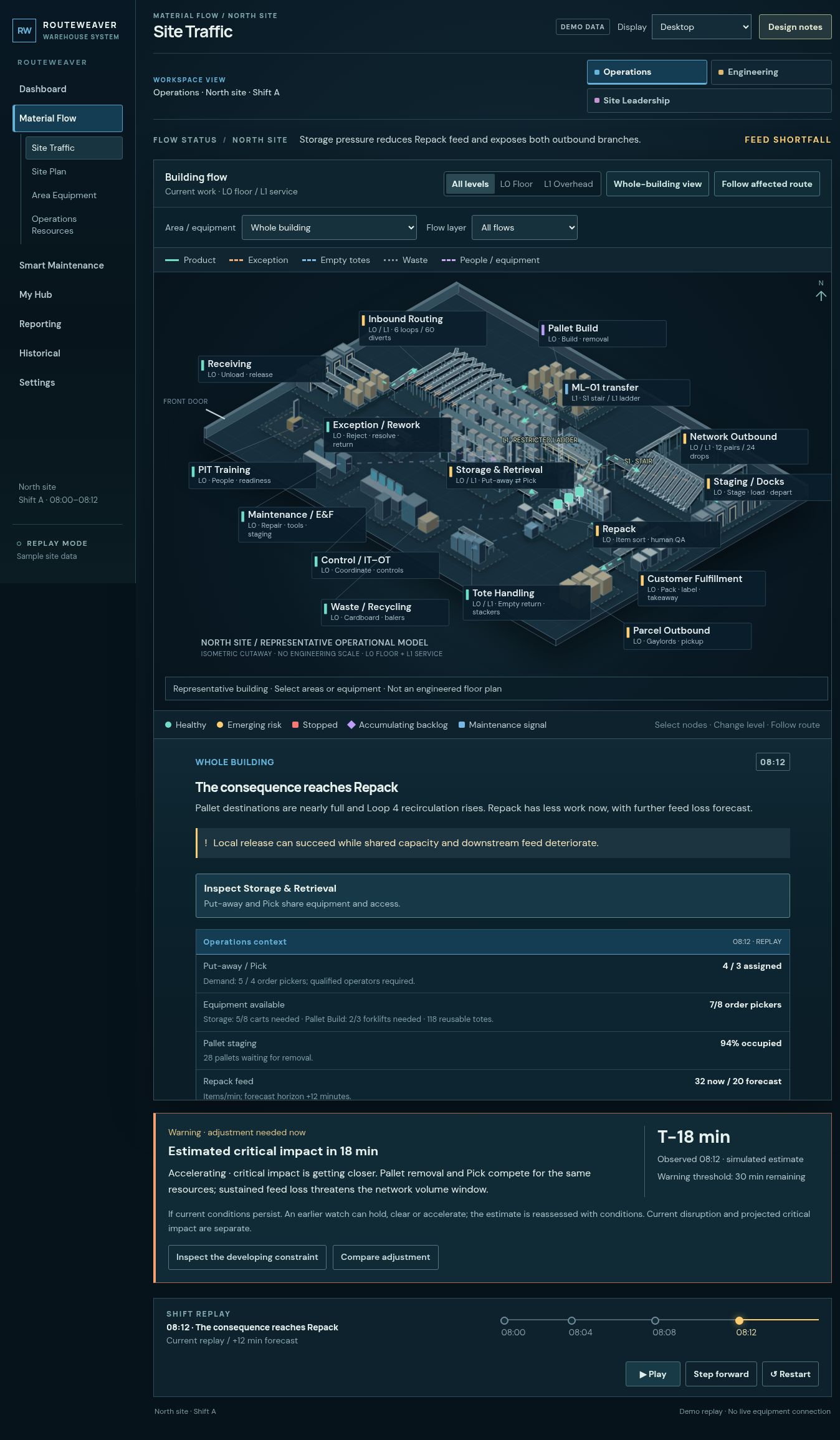
Explore Material FlowOne shared reality. Different decisions.
“We need First Pass Yield.” “Can I have another site’s dashboard?” “This alarm should text someone.”
I investigated the decision behind the request, current behavior, other systems consulted, and whether the need recurred across sites. Engineering joined when feasibility depended on equipment, controls, telemetry, networks, or vendor architecture.
Local workarounds were evidence of unmet needs, not specifications to copy.
These modules are represented in the current Smart Warehouse prototype.
CONCEPT · This prototype does not recreate every Target site or production screen. It connects recurring problems, delivered work, and future directions. Smart Maintenance was an engineering-led initiative; my contribution focused on UX, interpretation, and operational context.
Copied site implementations diverged, repeating maintenance and limiting consistent enterprise reuse.
Enterprise source of truth → site-specific configuration.
~90% reusable foundation · ~10% meaningful variation
Engineering feasibility research I initiated pointed toward this model. Installed equipment, telemetry, vendor systems, thresholds, terminology, and controls could still vary.
PROJECTED ARCHITECTURE · NOT ACHIEVED ADOPTION
Explore the scaling story →Shared models, clearer state, role-aware interpretation, workflow structure, alert relevance, training, interaction patterns, cross-site synthesis, and reusable product concepts.
Vendor access, proprietary systems, network architecture, uneven data, equipment differences, organizational ownership, enterprise repositories, and reliable predictive modeling.
The hardest problems were rarely contained inside one screen, one system, or one team.
Smart Warehouse reinforced a pattern throughout my career: complex products become difficult when people must reconstruct the real situation across disconnected systems.
State → context → consequence → ownership → decision