Customers
Is it booked? Where is it? Will it arrive on time? Is the destination ready? Which exceptions matter?
 ADDY RUTH
A shipment could be perfectly visible inside one workflow while the next person still did not know what to do.
Third-party logistics connects organizations that rarely share the same systems, priorities or operating context. Customers need confidence, carriers need viable freight, and brokers need to move volume while keeping control of exceptions.
As Redwood’s first UX designer and later UX lead, I worked across customer, carrier and internal products to reduce repetitive coordination, make state useful and automate straightforward work while preserving expert judgment.
CURRENT PROTOTYPE · CONNECTED LOGISTICS / FREIGHTLINK
A portfolio reconstruction of workflows and patterns from multiple Redwood initiatives—not one monolithic historical application.
Every handoff could add a system, a person, a status, a call or an email—and another opportunity for meaning to drift.
Preserve meaning as work crosses organizational boundaries.
Is it booked? Where is it? Will it arrive on time? Is the destination ready? Which exceptions matter?
Who fits this load? Is the rate viable? What needs negotiation, and what can proceed without me?
Does it fit my lane, equipment and rate? What restrictions apply? Can I accept without calling?
Where is coordination breaking down? Who owns the next action? What can the system automate?
Unusual equipment, difficult lanes, restrictions, pricing, relationships, failed service and uncertain capacity genuinely needed expertise.
Repeatable transactions could consume nearly the same attention. Where was a person adding judgment, and where were they relaying known information?
Understand the handoff → identify repeated judgment → express rules / state → automate the straightforward path → preserve intervention for exceptions.
Remove coordination that does not improve the decision.
Quote / shipment request · tracking · installation / destination readiness.
Load management · carrier matching · bids / award · exception management.
Available freight · eligible one-click acceptance · bids · assigned work.
SHARED CONCEPT FOUNDATION · Status, eligibility rules, exceptions and history connect cross-role work. This is the current portfolio model, not a claim that all workflows shipped together.
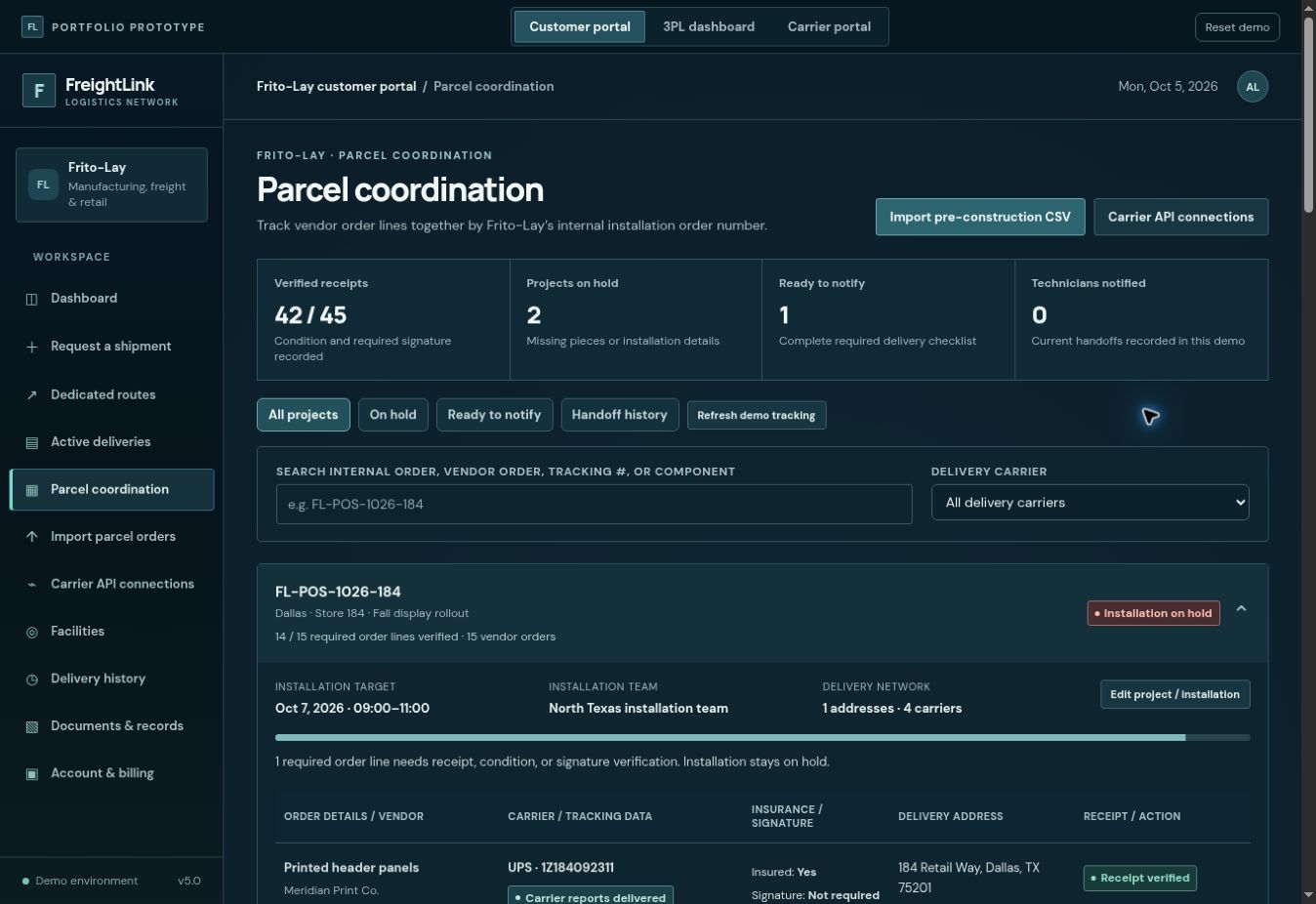
A store installation could depend on 15+ vendor/carrier deliveries. The next team needed project-level readiness, not another tracking number.
Group deliveries around the installation location / project and surface readiness and exceptions for the technician decision.
Explore Ready-to-InstallDesktop-heavy systems and slow screens mediated many tasks through representatives. Modernization brought faster web interactions and more direct customer/carrier access. Self-service reduced routine coordination; decision support narrowed complex choices.
The external acceptance path was easier enough that carrier representatives used it on behalf of drivers. That behavior exposed workflow friction rather than a simple staffing shortage.
The legacy board combined many fields, roles and abbreviated signals. Role-relevant views, meaningful status cues and details on demand supported faster interpretation. The redesign’s performance observations are separate from the one-click booking throughput result.
Annotated, white-labeled comparisons can show this supporting work later. The overview does not reproduce internal screens.
PORTFOLIO RECONSTRUCTION · Connected Logistics joins recurring patterns across several years and multiple initiatives. It is not presented as one application that existed in this exact form at Redwood.
Depending on the initiative: research / workflow analysis → wireframes / interaction design → front-end prototypes → HTML / CSS / Bootstrap → engineering implementation → QA / operational feedback.
My UX and front-end leadership made workflows concrete beyond a clickable frame.
Recovered workflows and business rules → system modeling → AI-assisted exploration → code-based prototype → connected cross-role state.
Make the workflow concrete enough to expose what does and does not work.
One-click acceptance, compared with an initial expectation of approximately 3–5%. This result belongs to that workflow.
Slow individual desktop screens compared with observed newer web interactions during modernization. Not a guarantee for every transaction or system.
Context for the capacity problem, not an achieved improvement metric. More staffing alone had not removed the workflow constraint.
Early modernization and self-service success contributed to continued investment in broader product redesign. Readiness and matching are described through their workflow changes, not borrowed booking metrics.
Coordination, workflow complexity, self-service, readiness visibility, matching transparency, decision support and cross-role handoffs.
Capacity, pricing, customer rules, external data, weather, traffic, relationships, driver/equipment availability, vendor delays and damaged or lost freight.
The goal was never to make logistics perfectly predictable.
Useful anywhere work crosses organizations, systems and people before the outcome is complete.