Every shipment could have a status and the store could still be unready for the technician.
IMPLEMENTED WORK · PORTFOLIO RECONSTRUCTION
Summary
A retail installation depended on equipment and materials arriving from multiple vendors and carriers. Individual tracking records could show where the pieces were, but not whether work could begin.
I reorganized the experience around the store/project, combining deliveries into one readiness view and exposing the exceptions that could prevent dispatch.
Tracking the pieces did not tell us the job was ready.
15+ incoming deliveries
Vendor A · equipment
Vendor B · materials
Vendor C · components
Additional parcel + freight deliveries
Each with its own carrier, tracking number, ETA and exception.
→
One store / installation
Are all required dependencies present and usable?
Readiness summarizes the job. Shipment details explain the answer.
Generalized dependency model, not a production portal screenshot. Requirements and delivery counts vary by installation.
1
The tension
Shipment status answered the carrier’s question better than the installer’s.
A package could arrive while a missing or damaged component still prevented the installation.
Shipment status
Where is this delivery?
Has it shipped?
When should it arrive?
Was it delivered?
Valid answers about one shipment.
Installation readiness
Can the next team begin?
Are all required items here and usable?
What is delayed, lost or damaged?
What needs intervention before dispatch?
A decision across the whole installation.
The important status was not “delivered.” It was “ready for the next team.”
2
Research + system
One installation crossed several organizational boundaries.
A store could depend on 15+ deliveries. The missing layer was dependency-level understanding across the job.
RECONSTRUCTION
Research → dependency model
01Vendor ordersEach vendor supplies part of the installation.
02Multiple carriersDeliveries move independently.
03Store / project receivingPhysical receipt is a separate event.
04HQ coordinationSomeone needs to assess all required dependencies.
05Technician dispatchThe installation can begin only when the prerequisites align.
Generalized reconstruction of the multi-vendor delivery and coordination problem. Carrier tracking evidence alone cannot confirm that every required item is present and usable.
Coordinators were piecing together statuses across carrier sites, spreadsheets and communication. Grouping by destination and project connected those fragments to the decision they actually needed to make.
RECONSTRUCTION
How the problem changed
01Track individual deliveriesEach shipment has its own status.
0215+ deliveries, one locationIndependent vendors contribute to one installation.
03Delivery is not readinessThe next team still has to reconstruct the whole job.
04Group installation dependenciesMake project / location the unit of meaning.
05Understand blockers before dispatchThe next action depends on required pieces being usable.
Reconstruction grounded in the shipped Frito-Lay readiness portal. The experience changed the organizing object from shipment to installation location.3
The pattern
Organize around the downstream decision.
Readiness is the summary. Shipment-level evidence remains available underneath it.
RECONSTRUCTION
Early design / decision model
01Shipment evidenceRetain the original carrier and tracking facts.
02Associate to project / locationConnect deliveries to the job they support.
03Validate required piecesReceipt and usability are different checks.
04Determine readinessAnswer whether downstream work can begin.
05Expose blockersMake the reason for the answer inspectable.
Reconstructed decision model, not historical version numbers or verified portal terminology. Readiness becomes primary while shipment detail remains supporting evidence.
RECONSTRUCTION · ILLUSTRATIVE SCENARIO
Store 1842
Not ready for installation
12 of 15 required deliveries confirmed usable
1 delayedExpected delivery outstanding
1 lostRequired component unlocated
1 damagedArrived, but not usable
Inspect the three blockers before considering dispatch.
RECONSTRUCTION · SAME ILLUSTRATIVE SCENARIO
What prevents readiness?
Required delivery
Evidence
Coordinator follow-up
Installation materials
Delayed · expected arrival not met
Check carrier timing and installation plan.
Equipment component
Lost · current location unresolved
Contact carrier/vendor to resolve fulfillment.
Required assembly
Delivered · damage reported
Review usability and replacement with the vendor.
Carrier, tracking number, timing and the associated requirement stay inspectable. These are example review actions, not automated replacement workflows.
Fictional store and example counts; no historical performance metric is implied. The damaged delivery is received but excluded from the 12 confirmed usable deliveries.
RECONSTRUCTION
Delivered is a shipment state. Ready is an operational state.
Ready
Required dependencies are present and usable; installation can proceed.
Delayed
A required delivery is expected later than planned.
Lost
A required item cannot be located through the expected shipment.
Damaged
An item arrived but cannot be assumed usable.
Needs Review Reconstructed addition
Incomplete or conflicting evidence requires human judgment.
Generalized state definitions. “Needs Review” is part of the portfolio reconstruction, not a verified shipped production label.
4
Design decisions
Design for readiness, not tracking density.
Make blockers easy to find without concealing the shipment facts behind the summary.
01
Group by the unit of work
Start with the store / installation / project. Tracking numbers support that job rather than define it.
02
Emphasize blockers
Normal progress can recede. Missing, changed or unusable dependencies need attention.
03
Separate receipt from usability
Delivered + damaged is not equivalent to ready.
04
Preserve the evidence
Keep carrier, tracking, timing, exception and requirement details available for investigation.
05 · Reconstruction
Make uncertainty explicit
Needs Review invites judgment when the evidence cannot support a confident answer.
RECONSTRUCTION
Detailed readiness workflow
01 · Entry point
Group the deliveries
Schematic view / evidence
Vendor and carrier records associated with the installation location.
User action
Open the location / project.
System / shared response
The required deliveries share one operational context.
Next → state 2
02 · Workflow state
Read the readiness summary
Schematic view / evidence
Required dependencies present and usable, or blockers remain.
User action
Determine whether the next team can act.
System / shared response
The summary identifies the need for review rather than forcing manual aggregation.
Next → state 3
03 · Workflow state
Open the blocker
Schematic view / evidence
A missing, delayed, lost or damaged required delivery.
User action
Choose the dependency preventing readiness.
System / shared response
The focused view retains the shipment and its associated requirement.
Review the evidence and coordinate with the relevant vendor or carrier.
System / shared response
Resolution stays connected to the dependency that blocked the job.
Next → decision below
DecisionAre all required dependencies present and usable?
Yes → coordinate the next teamReady for the dispatch handoff
The coordinator passes the readiness decision into technician coordination; this does not schedule the technician automatically.
No / uncertain → resolve the blockerHold dispatch and continue review
Coordinate missing, delayed, lost or damaged items, then revisit readiness with updated evidence.
Resulting state / return to evidenceRecheck project readiness after resolution
The next action follows the dependency state. The reconstruction does not invent replacement ordering, guaranteed availability or prevented-trip metrics.
Detailed wireflow reconstruction. Schematic task labels are generalized; exact historical portal labels and grouping remain a separate source-recovery item.
CURRENT PROTOTYPE · RECONSTRUCTION · SIMULATED DATA
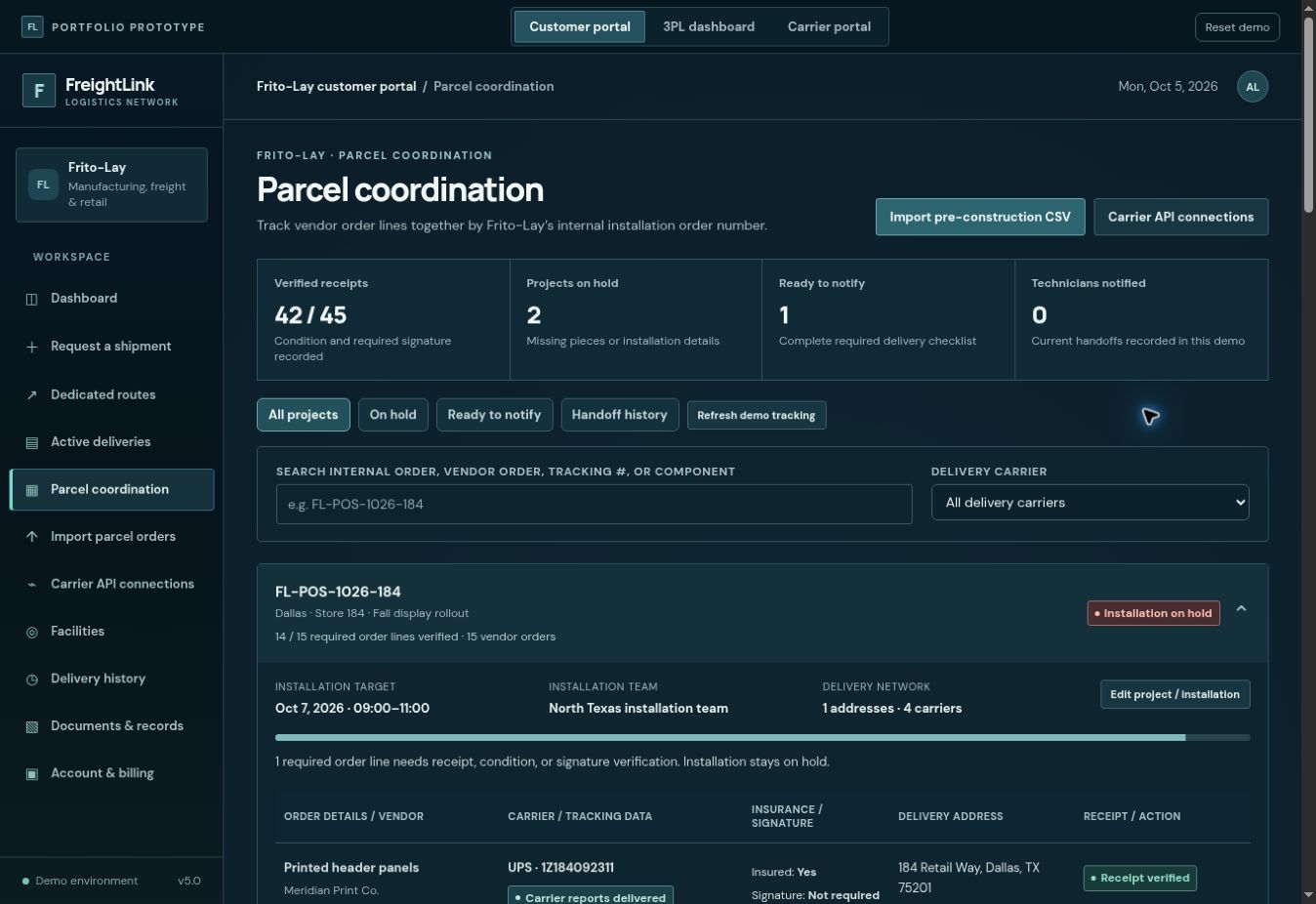
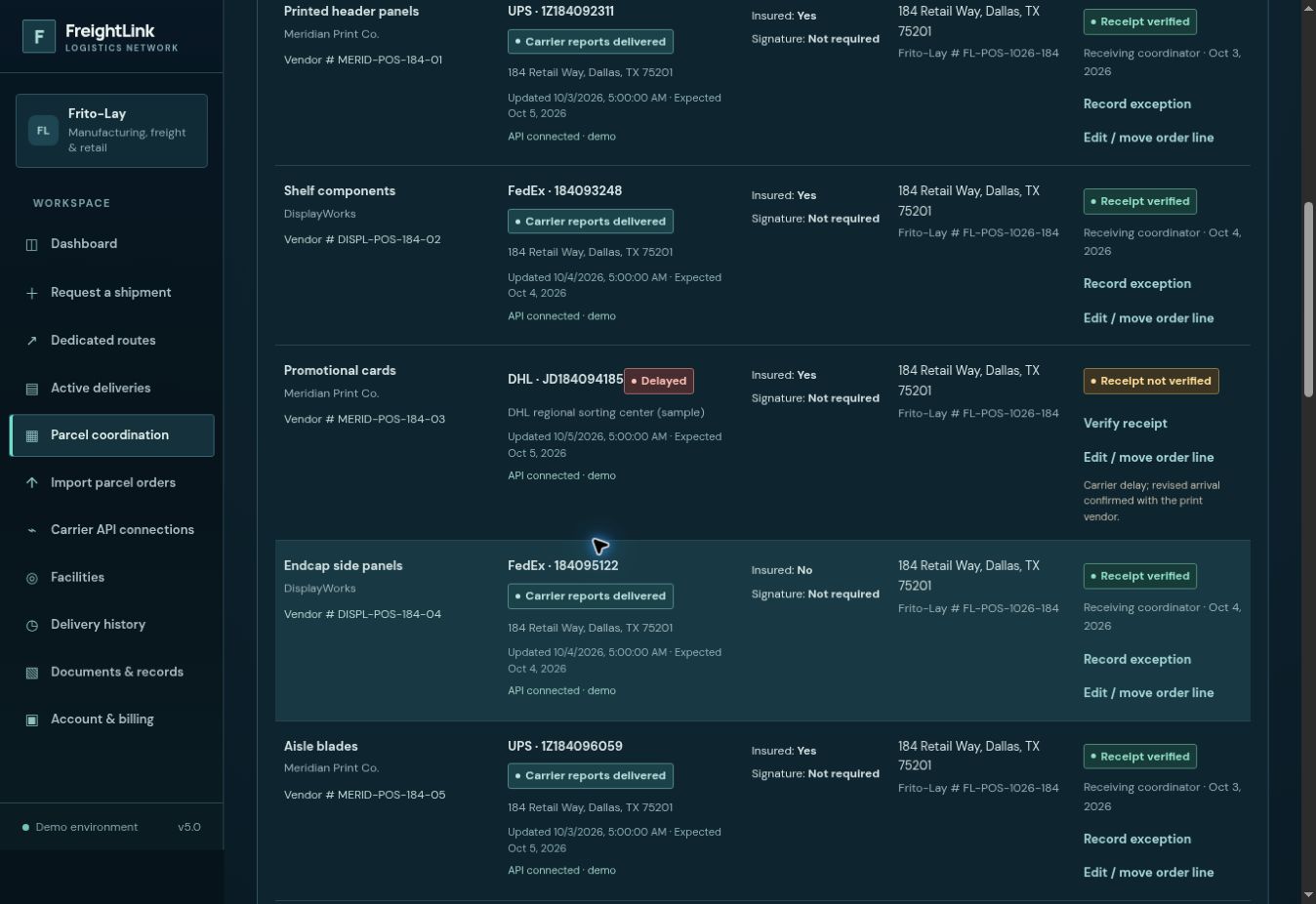
One project, fifteen dependencies
Current coded prototype: the project remains on hold until required receipts, condition and signatures are verified. Scenario: Customer portal → Parcel coordination → project readiness → open the delayed delivery. View full-size screenshot ↗Explore the prototype ↗View full-size screenshot →CURRENT PROTOTYPE · RECONSTRUCTION · SIMULATED DATA
01EvidenceScattered shipment states support one installation.
02DecisionOrganize by the downstream unit: project / location.
03TradeoffAggregation can hide a delivery’s source facts.
04ResponsePair readiness summary with shipment drill-down.
Reconstruction of the product decision. The summary supports coordination; underlying evidence lets users investigate and challenge it.5
Impact in reality
What shipped, and what is reconstructed.
Location-level readiness shipped. The current prototype extends the pattern without rewriting implementation history.
IMPLEMENTED
Store / project-level readiness
Multiple vendor deliveries grouped into a shared installation context.
Delivery and exception states, including delayed, lost and damaged.
Visibility into whether downstream work was ready to proceed.
OBSERVED / EVIDENCE LIMIT
A shipped coordination tool
The portal was used for headquarters coordination. It made blockers visible before dispatch.
No reliable quantified reduction in wasted trips, technician hours or missed windows is available.
PORTFOLIO RECONSTRUCTION
A more connected handoff
Explicit Needs Review, richer cross-role state, notification/handoff logic and subsequent-exception handling are reconstruction directions.
They are not claims about a completed historical dispatching platform.
IMPLEMENTED · GROUNDED SUMMARY
Implementation / outcome evidence
Implemented
Shipped Frito-Lay portal
A coordination tool for headquarters coordinators and dispatchers.
Product behavior
Multi-vendor deliveries grouped
Deliveries shared the context of the installation location / project.
Operational decision
Readiness visible
Shipment evidence informed whether the downstream job could begin.
Grounded implementation summary. Original portal screenshots are not reproduced. No conversion, dispatch-efficiency, wasted-trip or technician-hours KPI is claimed.
Reality check · what the system could and could not do
What it could clarify
Which locations were ready.
Which requirements remained outstanding.
Which exceptions needed attention before the handoff.
What remained outside the software
Incorrect shipments, physical damage, carrier delays, lost freight, receiving behavior, replacement lead times, technician availability and late or incorrect external data.
The system could make readiness visible. It could not make every dependency reliable.
From object status to operational readiness
Identify the downstream action.
Identify its required dependencies.
Group evidence around the outcome.
Separate normal progress from blockers.
Preserve drill-down evidence.
Make uncertainty explicit.
Hand off to the next team.
Useful anywhere multiple independent dependencies must converge before the next team can act.
 ADDY RUTH