Put rules before clicks
Establish eligibility before asking the carrier to accept.
 ADDY RUTH
Throughput ceiling → eligibility → direct acceptance → operational movement.
Straightforward freight still required a broker or carrier representative to carry the transaction through the system.
IMPLEMENTED WORK · PORTFOLIO RECONSTRUCTION
Booking had plateaued near 250 loads a day. A roughly ten-step desktop workflow—with individual screens taking 10–15 seconds—consumed attention even when the transaction needed little judgment.
I helped redesign the path around direct acceptance for trusted carriers and eligible freight, while preserving broker involvement for negotiation, exceptions and uncertain cases.
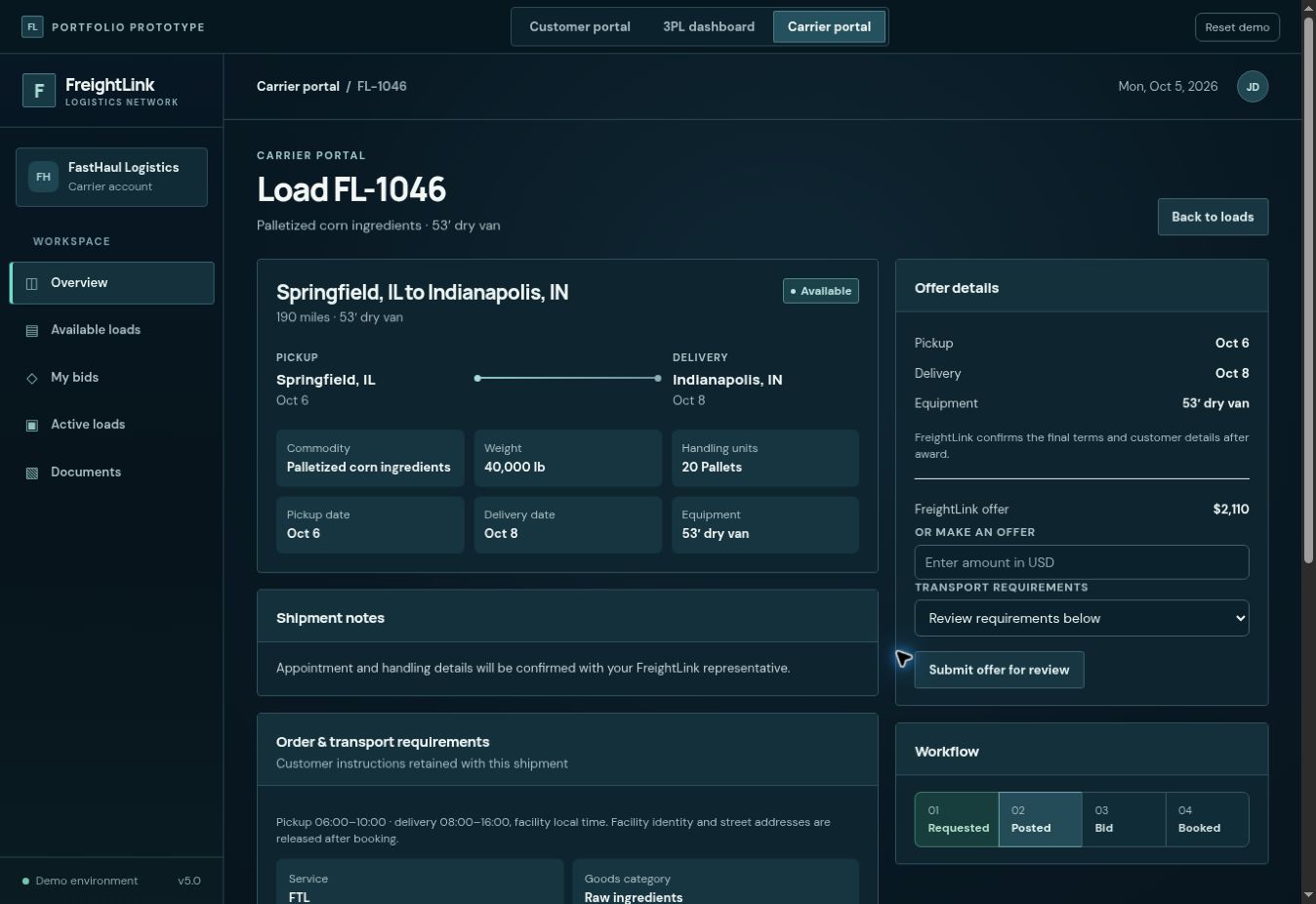
Explore in Connected LogisticsCurrent prototype: Carrier portal → Available loads → View details. Offer review is available; the historical direct-acceptance task is shown in the reconstructed wireflow below.
Simplified workflow reconstruction. The pilot used emailed offers to selected trusted carriers for suitable straightforward loads.
If a person is only carrying known information between steps, that handoff is a candidate for self-service.
The same mediated path served straightforward loads and freight that genuinely needed an expert.
Unusual equipment, difficult lanes, negotiation, customer restrictions, uncertain capacity, accessorials, relationships and exceptions.
Keep a person in the decision.
Known terms and a suitable, trusted carrier—but an internal representative still had to relay and record acceptance.
Carriers waited. Redwood spent human attention moving information.
Which parts of booking should no longer require an internal person at all?
Adding representatives did not remove navigation, waiting and repeated handling from a roughly ten-step desktop path.
Representatives began using the carrier-side link on drivers’ behalf because it was easier than the internal workflow. That behavior exposed the friction without requiring anyone to argue that the new path was simpler.
Users routed around the old workflow.
An executive carrier-marketplace prompt became a working prototype in four business days for an investor presentation. The team then chose a narrower behavior test: emailed offers for selected simple or dedicated loads, accepted directly by trusted carriers.
The larger concept made the service model discussable. The smaller pilot tested whether routine booking could move without a broker call, before investing in the whole marketplace.
A shorter interaction depends on confidence in both the participant and the transaction.
The operational system records the acceptance.
Uncertain capacity, requirements or terms stay with a person.
Selected straightforward or dedicated freight went through an emailed opportunity with direct review and acceptance. The reported +15% throughput result belongs to this narrow pilot.
Decision: accept known terms without requiring an internal person to relay the answer.
Complex requirements, pricing negotiation, capacity uncertainty and relationship-sensitive freight still need broker involvement.
Decision: investigate or negotiate instead of forcing the load through direct acceptance.
The rapid prototype explored a larger carrier experience. It led to a cheaper behavior test, not a claim that every marketplace capability was implemented.
Decision: test the core self-service behavior before building the broader product.
Trusted carrier, relevant availability and compatible equipment.
Known route, requirements and terms; no unresolved condition requiring negotiation.
Review essential details → Accept Load
Generalized eligibility model, not an audited production rules matrix. Route, equipment/accessorials, preferences, availability, customer restrictions, insurance/certifications, pricing and margin can affect eligibility; this generalized model does not disclose or verify exact historical production rules.
The UI became simpler because more of the decision was resolved before it appeared.
Self-service must commit to the operational workflow—not create another message for someone to re-enter.
Establish eligibility before asking the carrier to accept.
Prioritize route, timing, equipment, rate and relevant requirements—not the whole internal application.
Return ambiguous or exceptional transactions to a broker.
Confidence in the participant does not make every load suitable for self-service.
Acceptance needs to update booking, not leave someone backstage retyping the answer.
Eligible freight offered to a selected trusted carrier.
Origin / destination · timing · equipment · rate · relevant requirements.
The known carrier and load requirements still fit.
The booking is recorded and authoritative confirmation replaces relay or duplicate entry.
Resolve the changed terms or missing context. Do not imply a completed booking.
These are distinct resulting states. Direct acceptance commits the transaction; the exception path keeps human judgment available.
Selected trusted carriers could review and accept suitable freight directly. The first test had one response path.
Keep the outcome, prior constraint and later performance observation separate.
The earlier operating plateau—not a post-pilot total or a per-representative target.
Legacy individual screens commonly took 10–15 seconds. The newer web experience was closer to two seconds during partial rollout—not every transaction or screen.
The outcome suggests the opportunity was not merely interface efficiency. Removing waiting for an intermediary, repeated communication, context switching and re-entry of known information could create more capacity than a screen-only improvement.
This is interpretation, not a measured causal breakdown. The pilot and later latency observations do not establish how much each source of friction contributed.
Simplified external acceptance for selected trusted carriers and eligible freight, connected to operational booking.
Broader web modernization was separate work.
Representatives used the external link themselves. Pilot success helped support continued investment in Load Board and booking modernization.
Customer shipment state, broker load management, carrier opportunities, bids/awards and direct acceptance are brought together in the current prototype.
The unified prototype is not the historical product architecture.
Initial projection for the narrow acceptance pilot.
Bid-processing throughput from one-click acceptance.
Not a carrier-matching KPI or a result for the full marketplace.
Routine coordination, carrier friction and booking throughput for straightforward freight.
Negotiation, relationships, unusual equipment, difficult lanes, customer rules, pricing exceptions, uncertain capacity and service failures.
The goal was not fewer people. It was fewer situations where people were forced to behave like middleware.
Useful anywhere a trusted participant can safely complete a routine transaction without an intermediary.
Connected Logistics: understand the state → automate the certain → support the uncertain.