Explain why it surfaced
Make supporting factors inspectable instead of asking the broker to trust a number.
 ADDY RUTH
Hard constraints → credible candidates → explanation → broker judgment.
A carrier could look perfect mathematically and still be the wrong choice operationally.
IMPLEMENTED / EVOLVING WORK · PORTFOLIO RECONSTRUCTION
Carrier selection involved route, equipment, availability, accessorials, customer restrictions, preferences, pricing, margin, insurance, certifications, intermodal needs and relationship knowledge.
I helped turn that decision space into ranked guidance brokers could inspect and challenge—not an unquestionable answer.
Explore in Connected LogisticsCompatible equipment, a usable route, valid required credentials and known capacity make consideration possible.
Eligibility establishes the candidate set.Preferences, service history, timing, pricing and relationship context shape which eligible option is credible now.
Suitability helps prioritize attention.Generalized decision model, not a production screenshot or scoring-formula disclosure.
Matching reduced the search space. It did not remove the decision.
Manual search relied on experience and memory. A bare algorithmic score risked false confidence.
Formal requirements, recorded preferences, prior activity, pricing rules and known availability.
These could eliminate poor options and help rank the rest.
A recent conversation, a relationship concern, a changing market or newly available capacity.
An eligible lower-ranked carrier could still be the better first call.
Make expert judgment faster without pretending to replace it.
Some factors were mandatory gates. Others shaped preference, commercial viability or the broker’s next call.
Route, equipment, required accessorials, customer restrictions, insurance / certifications and intermodal requirements.
Preferences, availability, pricing, margin, recorded history and relationship knowledge.
A factor may be mandatory in one context and comparative in another. Hard gates do not become optional because a fit signal is strong.
Use rules to remove impossible choices and recommendations to prioritize plausible ones.
Wrong equipment, missing required credentials or a formal customer exclusion should prevent consideration—not merely subtract a few points.
Result: a candidate set that meets the load’s mandatory requirements. Unverified requirements still need review.
Compare eligible carriers using known lane fit, preferences, history, current availability and commercial context.
Result: a smaller set worth inspecting. A match score expresses relative fit, not guaranteed service or a probability of success.
Inspect the reasons, compare alternatives and apply knowledge outside structured data. Choose, skip or search further.
Boundary: override the ranking—not mandatory compliance or customer requirements.
The score helps sort. The evidence helps decide what to do.
Make supporting factors inspectable instead of asking the broker to trust a number.
Missing required insurance is not equivalent to a weaker lane preference.
A ranked list of hundreds still leaves the search problem with the broker.
Recent conversations and relationship context can justify choosing another eligible carrier.
Strong evidence of fit is different from simply finding no negative evidence.
Route · equipment · dates · customer · accessorials · commercial context.
Mandatory compatibility, customer and credential requirements.
Known lane fit · preferences · availability · history · pricing / margin.
Supporting factors and limited or stale context.
The broker owns the choice and the next booking or contact action.
Override the ranking, never mandatory requirements. Unverified eligibility remains a blocker.
The system narrows the search. It does not automatically award freight or treat a fit score as truth.
Repeatedly skipping highly ranked carriers could reveal stale preferences, missing customer rules, weak evidence or the wrong weighting.
Investigate the pattern with brokers. Do not treat every override as user error—or automatically train an opaque model on every click.
Expert override is evidence, not necessarily failure.
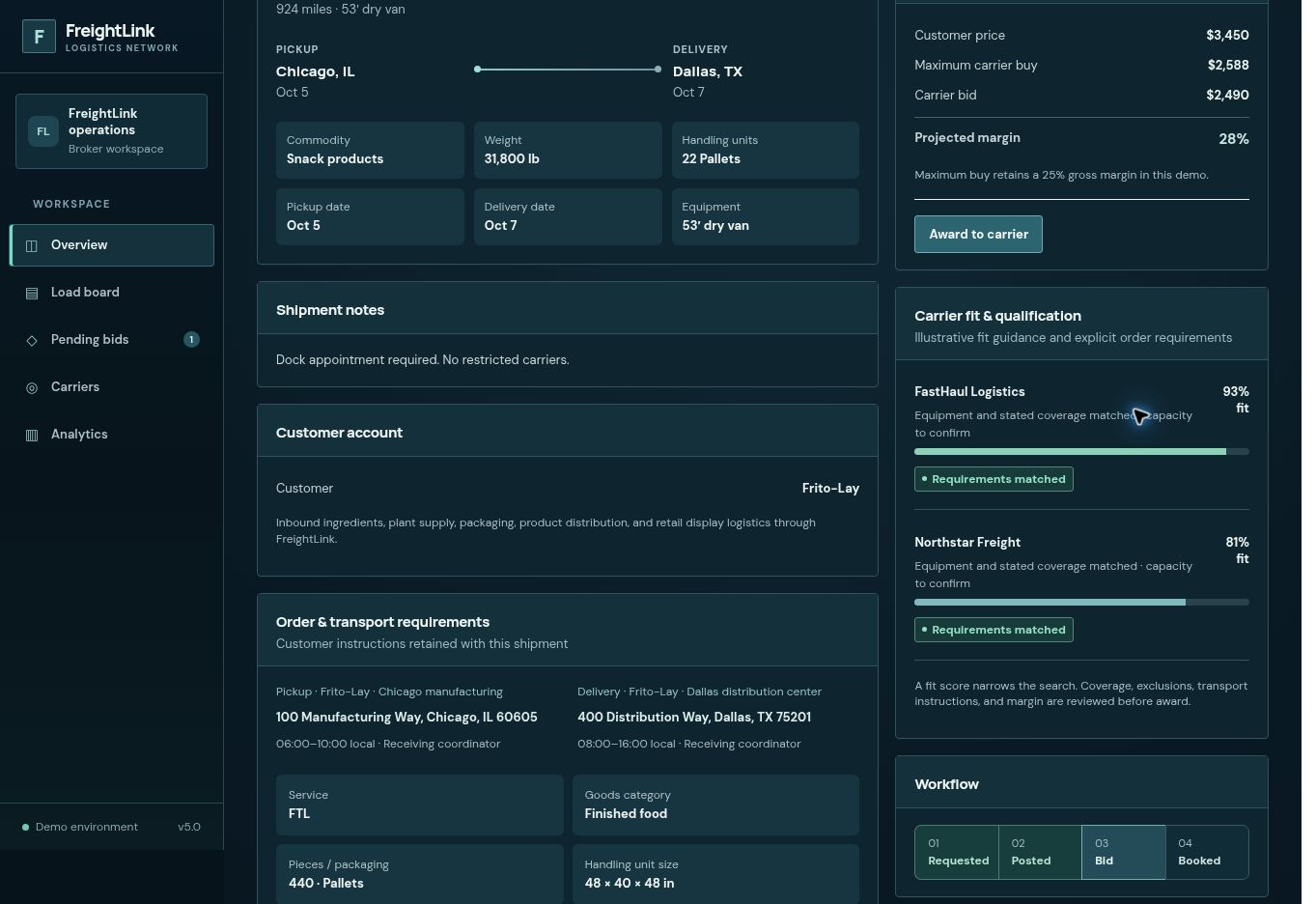
No independent matching-throughput or acceptance result is claimed. The +15% booking result belongs to the separate one-click pilot.
Multiple fit factors, eligibility constraints, graded ranking, thresholds and retained broker judgment.
A director authored the algorithm; my work shaped interpretation and the broker-facing decision experience. This summary does not establish an exact shipped version or historical threshold boundary.
Visible reason codes, clearer uncertainty, a stronger gates/preferences distinction and connected bidding/award context.
These explanatory behaviors are not all claimed in their current form historically.
Use repeated ranking overrides to question missing evidence and assumptions.
Not autonomous selection, automatic learning or a validated predictive model.
Equipment, route, formal customer restrictions, credentials, recorded preferences, historical activity, known availability and commercial rules.
Changing capacity, stale data, incomplete history, informal relationship knowledge, market conditions and recent conversations.
A recommendation is only as certain as the evidence it actually has.
Useful anywhere software can narrow a complex choice but should not pretend to own the final judgment.
Connected Logistics: interpret what is happening → automate what is certain → support judgment where uncertainty remains.