Staff / Principal Level Product Designer Automation • AI • Industrial UX • Decision Intelligence
TARGET / EQUIPMENT SIGNALS
From Equipment Signals to Coordinated Intervention
An alarm could tell someone that something changed without telling them whether they needed to act.
Summary
Warehouse automation generated extensive equipment state, alarms, faults and maintenance information. The harder problem was helping people interpret those signals in context: whether a condition was expected or abnormal, who needed to respond, what else might be affected and whether intervention was appropriate now.
I worked across alerting, diagnostics, reporting, training, and future maintenance concepts to connect machine state to the human decisions around it.
Operating meaningIs this a failure? Is it already being worked? Does Operations need to know? Can the equipment be taken offline now?
System boundaryIs the root problem inside this system, or does diagnosis require another application, owner, or physical inspection?
A signal becomes useful only when someone can understand what it means here, now, and for them.
1
The tension
More alerts did not create better decisions.
The early pilot proved that equipment conditions could reach people outside the application. Technical delivery worked; relevance remained unresolved.
A technically successful alert could still fail as an experience.
Broad Slack notifications could reach people who did not own the problem, were off shift, could not act or lacked enough context to judge urgency. They might not know whether someone was already responding. Some users disabled notifications.
The question changed: who needs this condition, when, and with what context to decide?
The right signal to the wrong person is still noise.
03Ad hoc Slack groupsSite and team workarounds add channels.
04Broad recipient listsReach does not establish relevance or ownership.
05Users mute notificationsDelivery succeeds while the experience fails.
Source-grounded research synthesis: the older Target FigJam documents layered alert noise and muted / disabled notifications. No notification volume or quantified causal effect is invented.
2
Research + system
A fault state was only one piece of the operating condition.
The same machine signal could lead to different decisions depending on the context around it.
Locate + reconstructWhere is the equipment? What changed? What state preceded the event? Which alarms or conditions occurred around it?
Interpret + coordinateIs it failed, manual or intentionally offline? Is the cause mechanical, controls-related, operational or downstream? Is someone already working it, and can Operations tolerate intervention?
Find the boundaryWho owns the next step? Does the condition cross into a vendor-controlled system?
The equipment was physically connected. The systems explaining it were not.
Diagnosis could require a separate vendor application, different terminology and metrics, separately provisioned access, or Engineering retrieving information unavailable to Operations. Teams might call internal support, escalate to a vendor, physically inspect equipment, or rely on tribal knowledge to translate between systems.
The physical system was continuous. Visibility, language, and ownership were not.
RECONSTRUCTION
How the problem changed
01Something changedThe alarm establishes an event, not its meaning.
02Expected or abnormal?Interpret the equipment state in context.
03Who needs to know?Target the person able to respond.
04Operational consequenceConnect the condition to affected flow.
05Appropriate actionCoordinate ownership and intervention.
Reconstruction grounded in alerting and diagnostic work. The design question moved from sending an alarm to supporting the decision around it.
3
The pattern
Show state, not just faults.
Equipment condition was not binary. Different states carried different urgency and next actions.
RECONSTRUCTION
Early design / decision model
HealthyOperating as expected.
DegradedRunning with reduced performance or reliability.
ManualNormal automation is not controlling the work.
Intentionally unavailableOffline by choice, planned work or operating need.
FaultedUnable to operate as expected.
Under interventionSomeone is already working the condition.
Reconstructed interpretation model: state before severity. These states frame different questions; this is not a verified historical status-picker UI.4
Design decisions
From signal to intervention.
A response progression: establish meaning, relevance, consequence, ownership, and the next action.
RECONSTRUCTION
Representative alarm workflow
01 · Entry point
State change appears
Schematic view / evidence
Location, event and preceding equipment state.
User action
Open the event and inspect context.
System / shared response
The condition can be interpreted beyond fault / no-fault.
Next → state 2
02 · Workflow state
Interpret expected versus abnormal
Schematic view / evidence
Planned unavailability, manual operation, degradation or fault.
User action
Check whether the condition is expected and whether someone is already responding.
System / shared response
A planned condition does not automatically become a critical interruption.
Next → state 3
03 · Workflow state
Target the relevant recipient
Schematic view / evidence
Responsible role · site · shift · off-hours relevance · current ownership.
User action
Determine who can investigate or act now.
System / shared response
A relevant response path replaces a broad notification blast.
Next → state 4
04 · Workflow state
Assess consequence
Schematic view / evidence
Affected Material Flow, downstream dependencies and operating demand.
User action
Compare the consequence before coordinating intervention.
System / shared response
Equipment health and operational tolerance inform the response together.
Next → decision below
DecisionWhat response does the evidence support?
Expected / already ownedMonitor or coordinate with the owner
Preserve the current context without creating another unnecessary interruption.
Abnormal / unresolvedAssign the appropriate responder
Investigate, coordinate intervention, or hand off across the internal / vendor boundary. Critical escalation is a later direction.
Resulting state / return to evidenceOwned response → recheck equipment and flow
Confirm the new condition and its operational consequence. Missing diagnostics or vendor evidence keep investigation open.
Representative wireflow reconstruction of the design logic, not one shipped end-to-end alarm product. Smart Maintenance was engineering-led; my contribution was UX, interpretation, diagnostics, escalation and the connection to flow.
01 / Interpretation
Separate signal from significance
Distinguish what happened from what it means operationally. A machine event does not establish urgency by itself.
02 / Relevance
Target relevance, not maximum reach
Consider role, site, shift, ownership, urgency and ability to act. Reach the person who can make the next decision.
03 / Thresholds
Preserve intermediate states
Where evidence supports it, distinguish Watch, Warning and Critical rather than jumping from normal to critical.
04 / Timing
Connect maintenance to operations
Read equipment health alongside flow, capacity, redundancy and planned work before coordinating an intervention window.
05 / Ownership
Preserve escalation across boundaries
Clarify internal, controls, network and vendor responsibilities. Make the handoff visible when local resolution is insufficient.
RECONSTRUCTION · PILOT EVIDENCE / CONCEPT
Pilot message versus targeted response; pilot behavior
Pilot / observed behavior
Standardized Slack channel
The condition reached users. Some muted or disabled notifications.
Insight: faster alerts were not enough.
Delivery did not establish relevance, current ownership or an appropriate interruption.
Later refinement / concept
Role-aware Slack / in-app response
Segment by role and context. Preserve off-hours relevance and escalation ownership.
Critical only: SMS + official escalation
A later direction for critical interruption, distinct from the first pilot.
Reconstruction from the older Target FigJam. Observed pilot behavior and later targeting / critical-SMS directions remain separate.CONCEPT · Targeting and intervention
Role-aware alerting
Notification relevance depended on role, site, shift, urgency, ownership, off-hours policy, escalation state, and whether someone could act. The goal was to reach a person who could interpret and act on the signal.
Off-hours: relevance changes when someone is not working
A condition useful during a shift may be an inappropriate interruption outside it. The model needs a current owner, an on-shift recipient and a path to escalate when the issue cannot wait.
Urgency should determine interruption, not merely the existence of a signal.
Earlier warning, where the evidence supported it
WatchSomething is changing.
WarningIntervention may soon be necessary.
CriticalThe operational consequence is occurring or imminent.
Pre-escalation thresholds were a design direction, applicable only where technically supportable. Not every equipment signal supported predictive thresholds.
What needs intervention, who needs to know, and when can the operation tolerate it?
Equipment health was only half the maintenance decision. This future direction connected condition with Material Flow, downstream dependencies, planned work, redundancy, operational demand and other active constraints. Is the equipment essential now? Is alternative capacity available? Would intervention now reduce or increase operational risk?
This context could support coordination; it did not establish that maintenance was safe. Intervention still required the applicable safety procedures and authority.
A maintenance recommendation is only useful if the operation can absorb it.
CURRENT PROTOTYPE · RECONSTRUCTION · SIMULATED DATA
02Role segmentationRelevance becomes a design problem.
03Pre-escalation signalEarlier warning only where evidence supports it.
04Actionable alertState, location, consequence and ownership.
05Critical escalationReserve interruption for the appropriate context.
Reconstruction of alerting evolution, not a sequence of recovered historical screens or independently shipped releases. The nearby coded prototype is a current implementation of the design logic.5
Impact in reality
What shipped, what we observed, and what remained directional.
The pilot, behavioral evidence, and broader maintenance direction remain separate.
IMPLEMENTEDThe structured alerting pilot created an official channel beyond scattered groups and email. Supporting work included diagnostic context, reporting/status and language improvements, and training/explainers.
OBSERVEDSome users disabled notifications. That behavior exposed weaknesses in relevance, timing, targeting, and ownership. Operational feedback also indicated value in clearer diagnostics and fewer unnecessary support/escalation cycles.
FUTURE DIRECTIONRole-aware escalation, predictive maintenance, planned work and maintenance windows, lifecycle context, historical performance, ownership mapping, and deeper Material Flow integration.
Richer targeting, predictive thresholds, critical SMS, and connected maintenance concepts were later design directions, distinct from the initial pilot.
Opting out was not merely resistance. It was feedback about relevance.
These are qualitative reports and observed behavior. No response-time percentage, validated failure forecast, or predictive-maintenance gain is claimed.
OBSERVED EVIDENCE · GROUNDED SUMMARY
Outcome / validation evidence
Change
Alerting + diagnostic improvements
Clearer equipment context and response information.
Observed feedback
Fewer Engineering & Facilities calls
Reported in team / department reviews.
Observed feedback
Lower off-hours escalation costs
Qualitative review evidence, not measured savings.
Observed evidence supported by team / department reviews. This is not a measured causal KPI, quantified cost reduction, predictive-maintenance result or validated failure forecast.
CONCEPT · Knowledge and ownership
Knowing what failed did not always tell someone who owned the response.
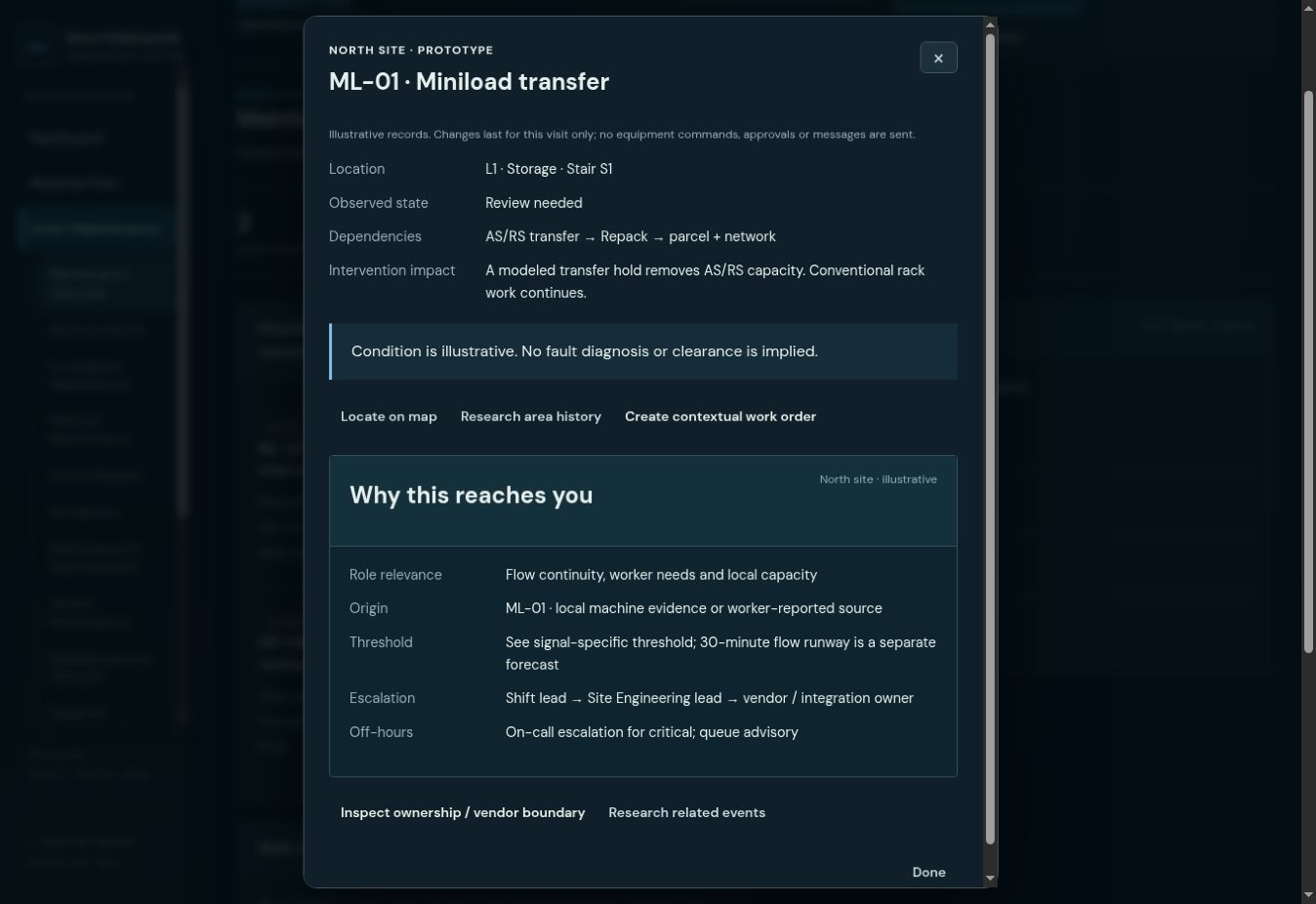
A physical asset could span a manufacturer, parts vendor, telemetry source, controls, connectivity, internal support, and external vendor support. A concept brought contacts, responsibilities, escalation paths, vendor links, procedures, and site-specific knowledge closer to the equipment.
If the technology cannot be unified, unify the knowledge around it.
 ADDY RUTH