When the Machine Can’t See the Problem
A worker could know something was wrong long before the automation system did.
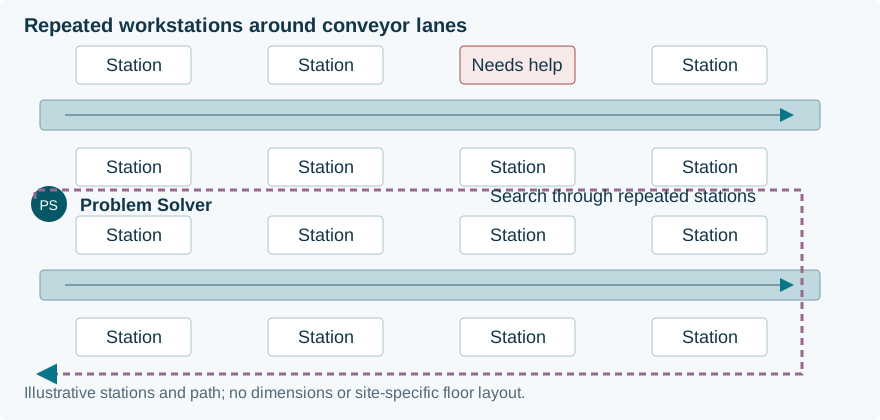
Problem Solvers supported a large, repeated workstation area where many issues originated with people, product or process rather than machine telemetry. Finding someone who needed help could mean physically searching the floor.
I helped connect a simple physical signaling system to digital visibility so human-observed problems could become shared operational state.
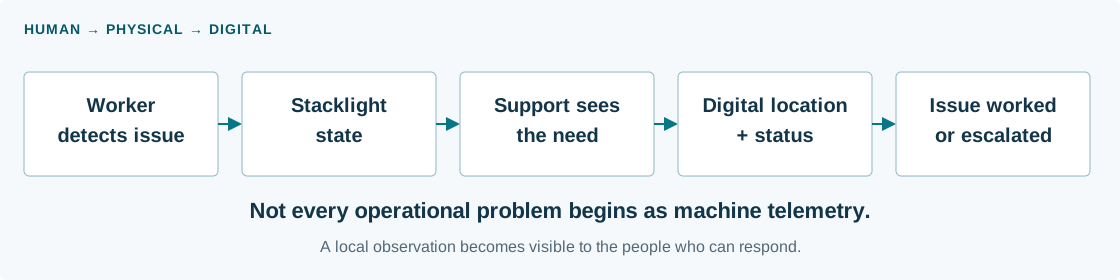
Human observation became operational telemetry.
The problem existed before the system knew about it.
Repeated workstations surrounded conveyor lanes, with working space on both sides. Problem Solvers were responsible for helping across the area.
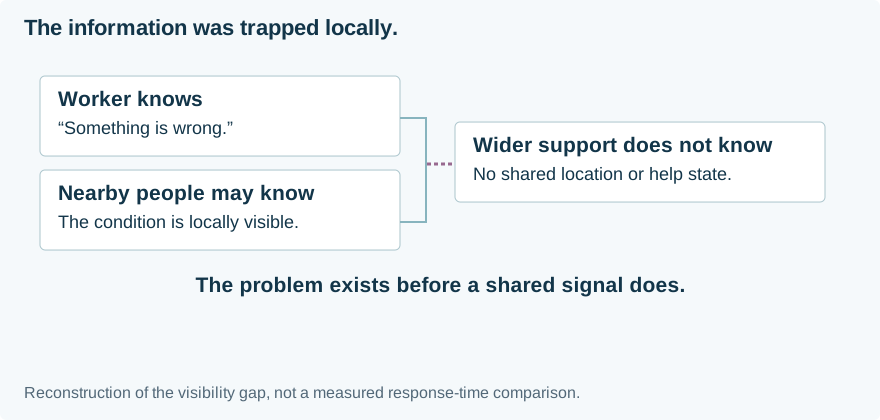
The information stayed local.
The signal existed only in the person experiencing the problem.
Make a human-observed condition visible across the area without requiring a complex digital task.
The physical environment was part of the interface.
Existing physical signals made needs visible. The opportunity was to preserve that immediacy while connecting it to shared operational visibility.
A worker needed an easy-to-activate signal, visible from a distance and understandable without opening an application.
Digital location and state could show where help was needed, whether someone had responded and when Maintenance was required.
The best interface for raising the issue was not necessarily a screen.
The screen became useful afterward: for location, coordination and state.
Research → physical environment
- 01Repeated workstation areaSimilar stations make an issue difficult to locate.
- 02People / product / processThe condition may not originate in equipment.
- 03Support covers a large areaOne Problem Solver must find the next need.
- 04Limited line of sightA local observation is not shared awareness.
One station signals. The area gains a location.
The support team has to find the problem.
The issue exists at one station. Without an explicit shared signal, a Problem Solver relies on local contact and walking the area.
Illustrative workstation count, positions and search path. No dimensions or site-specific floor layout are reproduced.
How the problem changed
- 01Worker sees the issuePeople notice product and process problems.
- 02Automation has no signalMachine telemetry cannot represent this observation.
- 03Support searches the floorKnowledge stays local without a shared request.
- 04Physical flag creates the signalRaise the need where the work happens.
- 05Digital visibility extends reachLocation and response state can travel beyond sight.
Three colors created a shared operational language.
The colors did not simply represent severity. They communicated need, ownership, progress and escalation.
Early design / signal-state model
- Red · requestNeeds Problem Solver attention. A worker has made the need visible.
- Yellow · ownershipThe Problem Solver is actively working the issue.
- Blue · escalationNeeds Maintenance attention. The required responder changes.
Color + explicit state
Needs Problem Solver attention
A worker has identified a condition requiring help.
- Location
- Workstation / conveyor location
- Support owner
- Problem Solver
- Next action
- Locate the station and acknowledge the request.
Waiting for support.
The state told people not only that something was wrong, but who needed to act next.
Detailed response workflow
- 01 · Entry point
Worker detects the issue
Schematic view / evidenceA condition is visible to the person, but not reliably visible to automation.
- User action
- Activate the request at the workstation.
- System / shared response
- Red makes the need for Problem Solver attention visible.
- 02 · Workflow state
Problem Solver locates the request
Schematic view / evidenceRed physical signal and shared location identify where help is needed.
- User action
- Go to the station and pick up the work.
- System / shared response
- Yellow communicates that the Problem Solver is actively working the issue.
- 03 · Workflow state
Problem Solver investigates
Schematic view / evidenceThe issue, local context and current ownership remain together.
- User action
- Resolve locally, or determine that Maintenance is needed.
- System / shared response
- The response can stay local or cross an explicit support boundary.
Return from the active request to resolved / normal operation.
Blue communicates the support need; Maintenance responds and resolves the condition.
The request no longer needs support. Need, ownership and escalation remain distinguishable throughout the response.
Connect the floor signal to shared operational visibility.
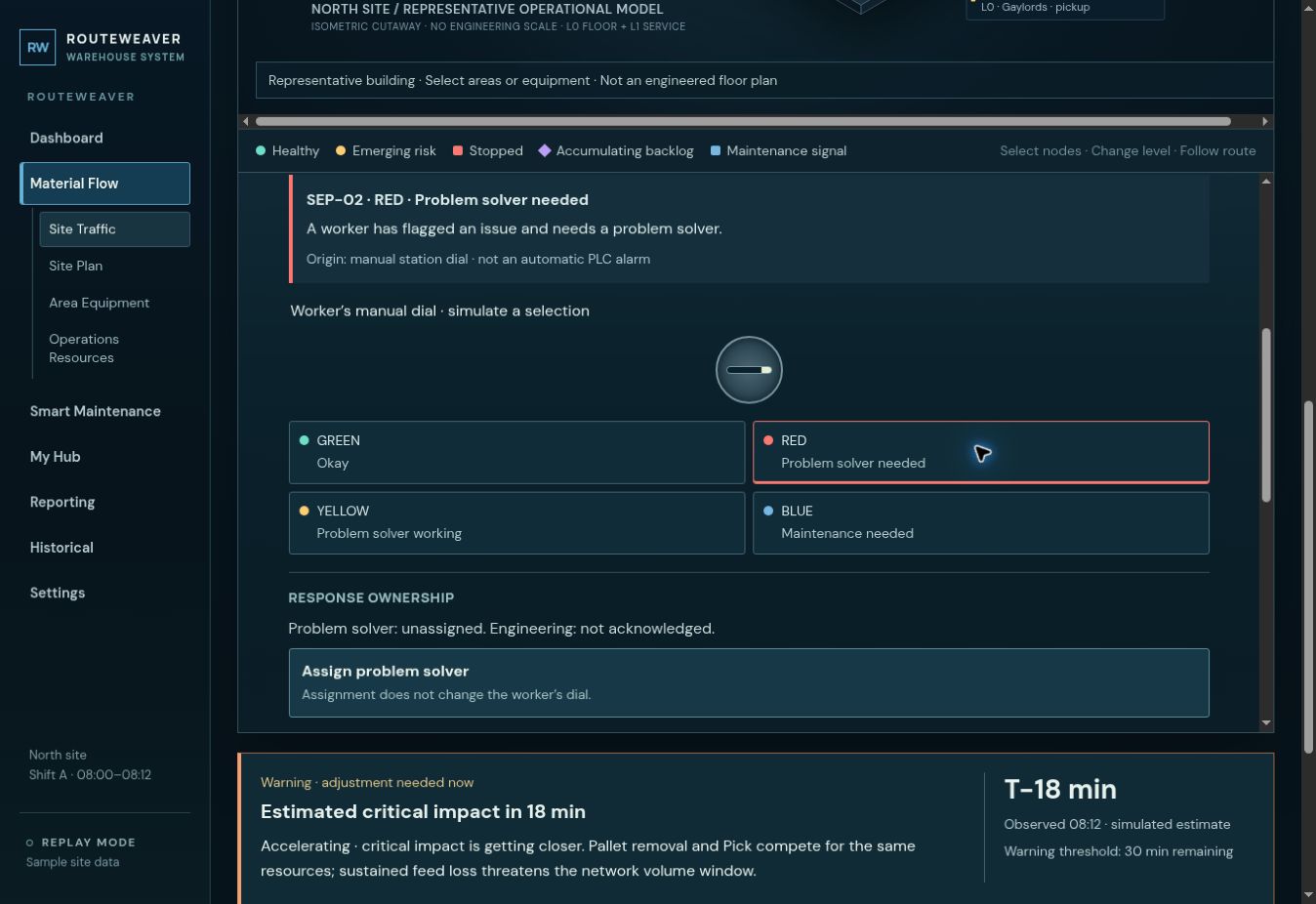
The implemented physical/digital relationship informs this Smart Warehouse concept. The dark view shows the future interpretation; it is not an internal production UI.
Section / Conveyor / Workstation
Locate the request. See who needs to respond.
Needs Problem Solver attention
- Responsible support
- Problem Solver
- Next action
- Locate the station and acknowledge the request.
Keep signaling immediate
A worker should not need to stop work and navigate a complex application just to ask for help.
Encode ownership in the state
Distinguish waiting for a Problem Solver, active work and a need for Maintenance.
Extend visibility beyond line of sight
Show the request’s location and current state to support teams beyond direct sight.
Preserve escalation
Make Problem Solver → Maintenance a visible state transition, rather than an informal side conversation.
Human observation became operational telemetry.
Explore the connected prototype →A worker request becomes visible to support
Evidence → Decision → Tradeoff
- 01Human observationThe worker already knows the issue exists.
- 02Low-friction physical signalMake the need visible without a digital reporting task.
- 03Ownership + progressSeparate waiting from active response.
- 04Beyond line of sightConnect the request to shared digital visibility.
- 05Preserve escalationMaintenance need remains a distinct state.
What shipped, what we observed, and what remained directional.
Implemented across three sites, with broader expansion planned. Future applications remain concepts; no quantified response-time improvement is claimed.
3 sitesThree-color SICK workflow
- Red / Yellow / Blue states at workstation/conveyor locations.
- Dashboard visibility tied to location and state.
- Response-state history.
Explicit shared states
- Used across three sites.
- Made need, ownership and progress explicit.
- Replaced reliance on manual search with a shared, locatable signal.
Other human-observed exceptions
- Inbound assistance.
- Manual work blockage.
- Cage-cart / resource problems.
- Limited equipment availability.
- Other floor-level conditions automation cannot detect.
Supporting response history
The system could record the responder’s zID, duration in Red, duration in Yellow and, if Blue, time until Maintenance resolution. History supported the workflow; visibility was the central problem.
Field descriptions only. No internal IDs, records or responder information are reproduced.
A local observation became shared, locatable work.
Pilot / rollout evidence
- 01Implemented at 3 sitesPhysical signal and digital response workflow.
- 02Validated in live operationsNeed, ownership and progress tested in field use.
- 03Broader expansion plannedPlanned scope remains distinct from completed rollout.
Reflection & Takeaways
Reality check
What worked. What remained hard.
What worked
- Simple physical state.
- Explicit support ownership.
- Signal visible in the environment.
- Digital visibility beyond direct sight.
- Escalation from Problem Solver to Maintenance.
What remained hard
- Someone still has to notice and activate the signal.
- Not every problem fits three states cleanly.
- Installation and layout matter.
- Digital state depends on the response process behind it.
- Escalation does not resolve underlying equipment or vendor complexity.
Visibility does not replace response capacity. It makes that capacity easier to coordinate.
Transferable pattern
From human observation to system-visible work.
- Identify problems people see before software can
- Minimize the effort required to signal them
- Encode ownership and progress
- Connect the signal to location and context
- Preserve escalation across roles
- Record response history where it supports learning
Useful anywhere frontline workers detect exceptions before software does.